
Most people don’t know admissions officers notice rhythm in your sentences, not just facts. I’ll show you how to open with a scene that smells like Sunday dinner and sounds like church choir, then pivot to the exact moment you learned you belonged—no humblebrag, just proof. You’ll sketch one vivid memory, name a concrete result, and leave a question the committee can’t ignore, so you keep them leaning forward, not drifting off.
Key Takeaways
- Start with a vivid, specific hook that reveals your identity or a meaningful cultural moment.
- Show, don’t tell: use sensory details and dialogue to illustrate growth and values.
- Connect your personal story to HBCU community, explaining mutual impact and fit.
- Balance reflection and concrete achievements with measurable outcomes and obstacles overcome.
- Revise aloud, tighten verbs, remove fluff, and get feedback before saving as a clean PDF.
Choosing a Topic That Reflects Your Identity and Values
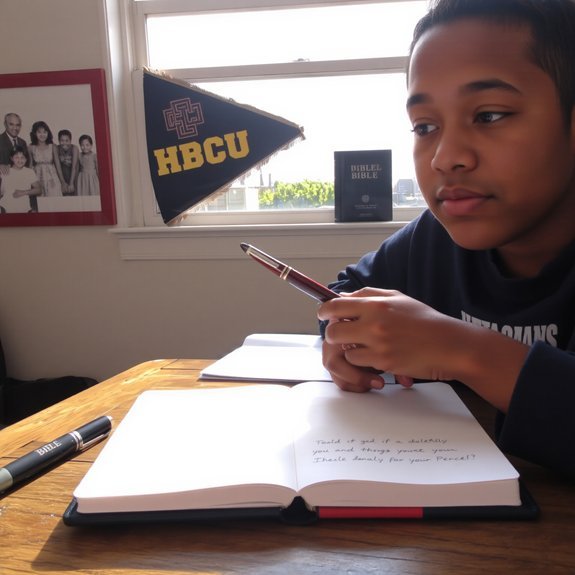
If you want your essay to sing, start with something that actually belongs to you — a real corner of your life, not a dusty idea you picked off a list. I want you to fish in your backyard, not the clearance bin. Describe the sound of your grandmother’s laugh, the smell of Sunday rice, the scrape of sneakers on gym floorboards. Show the tiny habit that reveals you—tucking a lucky pen behind your ear, apologizing first, ordering extra hot sauce. Don’t brag; narrate. Pick moments that expose values: persistence, curiosity, care. You’ll write scenes, drop short dialogue, let sensory detail do the heavy lifting. If a topic feels staged, toss it. Be honest, specific, and a little charmingly awkward — that’s memorable.
Opening With a Memorable Hook

You’ve got to snatch the reader from the first line, like grabbing a hot tray before it slides off the counter. I’ll show you how a sharp image, a quick quip, or a tiny scene makes your stakes clear—so they feel what’s on the line for you. Let’s craft a first sentence that smells like coffee, sounds like your voice, and makes them keep reading.
Grab Attention Immediately
Why should anyone keep reading past the first line? You grab them by smelling coffee, hearing rain on the window, or spilling a secret so small it’s funny. Open strong: paint a quick scene, drop a line that makes them blink, then lean in. Don’t lecture, surprise. Use a sound, a small action, a bold claim — “I stole my grandfather’s trumpet,” works because it’s weird and immediate. Keep sentences snappy, toss in a wry aside, let your voice poke through like a friend in the doorway. Cut setup, show the moment. You want an editor to smile, jot a note, keep turning pages. If you can make them hear or laugh, you’ve already won half the battle.
Show Personal Stakes
Stakes matter — not the vampire kind, the kind that make your palms sweat and your jaw clench. You open with a moment that costs you something: a busted scholarship, a slammed door, a promise whispered at dawn. I want you to smell hot pavement, hear your own breath, feel the weight of a decision. Say why it hurt, why it mattered, and what you did next. Don’t lecture, narrate—show the bruise, the small victory, the stubborn grin. Use dialogue: “You’re leaving?” someone asks. “I have to,” you say. Those lines pull readers in. Personal stakes turn anecdotes into urgency, they make admissions officers lean forward, they make your story feel alive, risky, and impossible to forget.
Showing, Don’t Just Telling: Using Specific Moments

Picture the cafeteria smell of cinnamon rolls and burnt coffee, and don’t tell me you “learned resilience”—show the minute you stayed late tutoring a kid who cried over fractions. Use crisp sensory beats, like the scrape of a chair, the anxious gulp, the lightbulb click, to make that scene feel lived-in, not summarized. Then I’ll help you pull a tight reflection from the moment, quick and honest, so the lesson lands without lecturing.
Scene, Not Summary
You don’t get into an HBCU by saying you were “inspired”—you get in by dropping us into the moment you were, so we can feel it. You show a scene: the bell clanged, your hands shook, you fumbled the mic and said the one line that changed everything. Don’t summarize that day, stage it.
- Start with a beat: traffic, sweat, the smell of cafeteria fries—then cut to your choice, the line you spoke.
- Put in tiny dialogue, a quick exchange, so we hear voices, not a report.
- End the scene with action, not analysis—walk out, drop the notebook, laugh. Let admissions infer the growth; don’t hand them the conclusion.
Sensory Detail Anchors
Think of a single spoonful—the cold, gritty cereal hitting your tongue, the fluorescent hum above, your elbow knocking a sticky table—then hang onto that. I want you to drop readers into that small, bright mess. Name textures, sounds, smells; let them taste the crunch. Don’t lecture about resilience, show the chipped mug you gripped, the late bus hissing away, the apology you swallowed. Short lines, quick beats, a tossed-off joke; that’s how you keep it human. Use sensory anchors to return them to the moment whenever your essay wanders. They’ll remember a damp sleeve before they remember the word “perseverance.” You won’t over-explain. You’ll let scenes do the heavy lifting, sly and honest, like a wink across a cafeteria.
Moment-Based Reflection
Reflection matters, but moments do the convincing. You don’t just tell admissions you grew; you show the exact crack in the classroom window, the heat of the debate, the way your hands trembled when you passed the mic. I’ll nudge you to pick one scene, freeze it, then unpack why it changed you.
- Describe the scene: the smell of chalk, your teacher’s sigh, the buzzing phone — small details make it real.
- Show the action: you swallowing, stepping up, saying the line that mattered; let the reader hear the clap, see the sweat.
- Link to insight: name the lesson, briefly, honestly; don’t lecture, let the moment do the moral.
Demonstrating Cultural Awareness and Community Impact
If you want your essay to sing, start by showing how your world smells, sounds, and acts—and don’t just tell me you care about community, make me step into it with you. I’ll coach you: name the church choir’s sticky hymnals, the late-night kitchen debates, the neighbor who fixes bikes for spare change. Show a scene where you hand out flyers, joke with kids, and swap recipes—brief dialogue, one line, crisp. Say what you learned about respect, not as a platitude, but as a muscle you built. Don’t generalize culture; point to rituals, language, food, music, gestures. Link those moments to real impact: a single repaired bike, a summer class that kept someone reading. Keep it human, specific, and rooted in place.
Balancing Personal Growth With Concrete Achievements
While you’ve been busy growing, don’t forget that colleges actually want receipts — the stuff you can point to and say, “I did that,” not just “I changed.” I’m telling you this because you’ve got to thread the feeling and the fact together: the late-night panic that pushed you to start a weekly tutoring club, the scratchy marker smell of schedules taped to the guidance office wall, the exact day the attendance doubled when you brought pizza. You’ve got stories, and you’ve got stats. Show both. Be specific, brag a little, then show the work. Don’t dramatize growth without proof. Here’s how to balance it:
- List measurable wins, numbers, dates, concrete outcomes.
- Tie one sensory moment to each win, quick and vivid.
- Mention obstacles briefly, then the action you took.
Crafting a Clear Narrative Arc
Because your essay needs to feel like a small movie, start by deciding what scene actually carries the story — the moment that, if you cut everything else, still tells who you are. I want you to pick that scene, smell the cafeteria rice, hear the echo of your sneakers, feel palms sweaty, and then zoom in. Begin with action: a line of dialogue, a stumble, a decision. Let that scene set the stakes, show change, and point toward what you learned. Don’t scatter scenes like confetti; sequence them so cause leads to effect. Use short beats, then breathe with a few longer lines. Tie the ending back to the opening image, wink at the reader, and leave a clear, satisfying arc — no loose ends, just purpose.
Editing for Voice, Clarity, and Authenticity
Once you’ve chosen your scene, don’t treat the draft like a museum piece—get in there with a pen and a stubborn grin, and start hacking away at anything that sounds like a brochure. You want your voice to breathe, not echo in a hollow hall. Read aloud, hear rhythms, clip pompous phrases, swap vague words for concrete ones — the warm smell of coffee helps, or at least pretends to. Trust your quirks, ditch lines that sound like other people’s essays, and keep the sentences that make you wince in a good way.
- Read aloud, record, and note lines that feel fake.
- Replace fluff with specific sensory detail.
- Ask one honest friend to flag off-brand moments.
Final Checklist Before Submission
Ready to launch this essay into the wild? I’m right there with you, heart thumping, fingers hovering. Read it aloud, walk the sentences, listen for clunky bits, and toss the jargon. Check your opening—does it zing? Scan for specifics, dates, names, smells, the little moment that proves you. Fix grammar, tighten verbs, lose passive fluff. Confirm word count, file format, and that your name’s spelled like you, not a typo’s idea of you. Save a clean PDF, back it up to the cloud, and email a copy to someone who’ll be honest. Breathe. Change the title if it’s boring. Preview submission, hit send only after you’ve waited thirty seconds—then celebrate, cautiously. You did the work; now you launch.
Conclusion
You’ve got this: choose a true topic, craft a catchy hook, and show small scenes that sing. Be bold about blackness, brief about bragging, build a clear arc. Polish your prose, prune the passive, and proof like a pro. I’ll cheer from the sidelines, but you’re the storyteller—so write with heart, sharpen with honesty, and submit the essay that sounds like you, says something, and sticks. Good luck, go get it.
Leave a Reply