
Funny coincidence: you and that scholarship both want the same thing — a story that sticks. I’ll tell you how to pick one vivid moment from your HBCU life, turn it into a scene with smell, sound, and a single honest line of dialogue, then tie it to your goals so the committee feels the arc. Stick with me, I’ll keep it sharp, and you’ll walk away with a draft that actually earns a second look.
Key Takeaways
- Open with a vivid HBCU scene that establishes your thesis and draws readers into your campus-centered story.
- Choose one or two specific anecdotes showing growth, resilience, and community impact rather than listing achievements.
- Use sensory details, dialogue, and clear outcomes to make your HBCU experiences memorable and authentic.
- Align your future goals with the funder’s mission, quoting or echoing their priorities and describing measurable impact.
- Keep paragraphs concise, proofread aloud, and polish for clarity, voice, and error-free submission.
Why Your HBCU Story Matters to Scholarship Committees
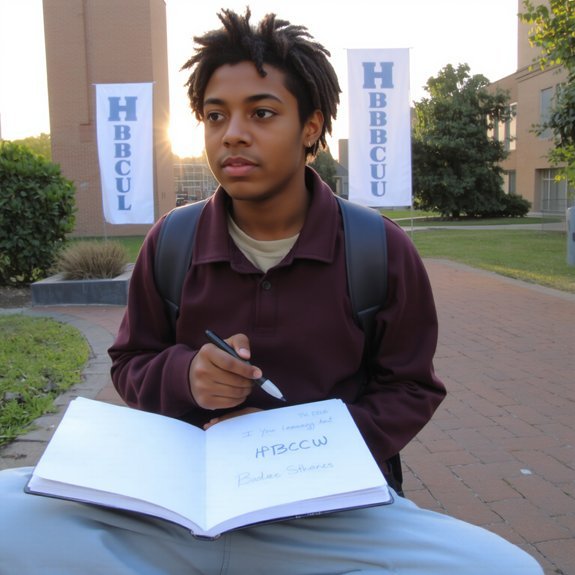
Look, your HBCU story isn’t just a background note—it’s the headline. I mean it: committees want the scent of campus food trucks, the clack of dorm hallway laughter, the way you learned to lead in a noisy choir rehearsal. You show them context, grit, and cultural intelligence. Don’t bore them with facts; paint a scene. Say, “I carried textbooks and weekend joy,” and they’ll feel your footsteps. You’ll prove resilience when you describe late-night study sessions, the mentor who nudged you, the community fundraiser you organized in sneakers. That specificity tells selectors you’ll contribute, not just consume. Be vivid, be human, and yes, be a little funny about your sleep-deprivation—humor makes you memorable.
Choosing the Right Anecdotes That Showcase Your Journey
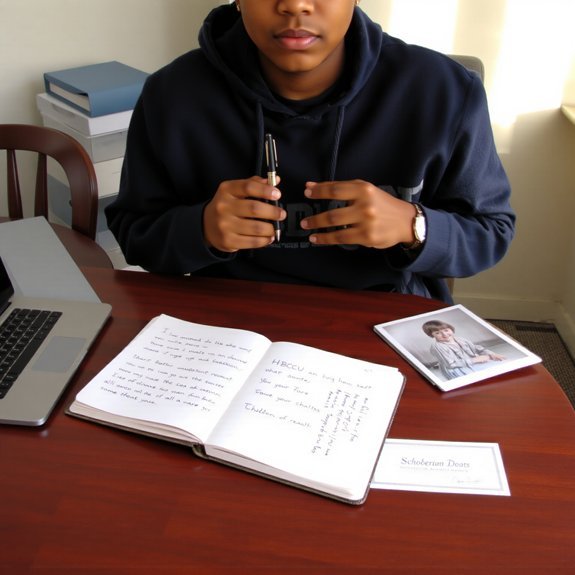
You’ve already sold them on the smell of campus cookout smoke and the squeak of dorm-room slippers; now pick the small, sharp scenes that prove you grew there. Choose moments that show change, not just charm. Tell about the time you stayed past curfew to finish a group project, the coffee-stained page where you sketched a solution, the nervous laugh before your first student-government speech. Drop a line of dialogue, like “I can fix this,” and let action follow. Use senses — heat from the grill, the chalk dust on your hands — and show how you learned, stumbled, and got back up. Skip grand statements, focus on tiny proofs. Be honest, crisp, funny when you can, and always end with a clear, small win.
Aligning Your Goals With the Funder’s Mission

You’ll want to line up your goals with the funder’s mission like you’re matching shoes to an outfit — it looks effortless when it’s right. Point to specific ways your work will lift your campus or neighborhood, paint a quick scene of the change, and name measurable results they can picture. I’ll show you how to make that connection crisp, believable, and impossible to ignore.
Match Mission to Goals
A few quick questions before we explore: what lights you up, what problem do you want to fix, and how does that line up with this funder’s vibe? I’ll say it straight: funders want fit, not fantasy. You map your goals to their mission like matching color swatches, except with campus projects and grant language. Name a specific aim, show one clear action you’ll take, and cite how that action echoes a line from their mission statement—quote it, don’t paraphrase into mush. Paint a tiny scene: you leading a workshop, fingerprints on chalk dust, students nodding. Then tie it back: “this funder backs workforce readiness,” you write, “so my curriculum builds job skills.” Tight, concrete, and undeniably aligned. They’ll see you’re not dreaming blind.
Demonstrate Community Impact
Okay, now that you’ve shown how your goals echo the funder’s mission, let’s prove it actually matters to people. You talk about results, not just dreams. Say you tutored math in a hot church basement, watched test scores climb, felt pride fizz like soda on your tongue. Name numbers, timeframes, faces—“I helped 12 students raise scores by 15% in three months.” Show photos of events, share a quoted thank-you, describe a lunchroom conversation that shifted a mind. Explain how your campus plans scale that success, who benefits next, and why the funder gets credit. Be specific, humble, bold. I’ll wink, you’ll nod—together we turn passion into measurable impact they can fund.
Crafting a Compelling Narrative Arc
If you want your scholarship essay to feel less like a resume and more like a movie, start thinking in scenes not bullet points; I’m talking about smells, small fights, and that one sentence your grandmother said that changed everything. I’ll tell you how to shape that into an arc, so your story breathes, moves, and lands. Open with a moment, raise the stakes with a messy middle, then give the reader a clear turn. Don’t summarize growth, show it.
- Hook them with a vivid opening scene.
- Add obstacles, choices, and small defeats.
- Show the pivot, the lesson in action.
- End with a future-facing image, not a preachy conclusion.
You’ll craft momentum, keep them leaning forward, and leave them smiling.
Balancing Confidence and Humility in Your Tone
You just finished staging that little movie of your life — the kitchen spat, the smell of frying plantains, Grandma’s line that hit like a thunderclap — and now you’ve got to talk like someone who’s proud but not braggy. You lean into specifics, name the stew, admit you burned the rice once, laugh at your own mistakes, and then show how you learned. Say “I led,” not “I single-handedly saved the world.” Drop the trophy pose, keep the handshake. Use active verbs, short beats, a crisp example, then a humble takeaway: gratitude, community, curiosity. Let your voice be warm, clear, a wink and a nod. Confidence is your spotlight, humility is the rim light — both needed, neither overpowering.
Practical Structure, Word-Count, and Formatting Tips
Start with a clear thesis sentence that tells the reader what you’re arguing, like a bright neon sign over your essay, and I promise it makes everything that follows feel ordered instead of messy. Keep paragraphs to about 3–6 sentences so each idea breathes — think bite-sized chunks you can read between sips of coffee — and aim for a total word count that fits the prompt, not your ego. Use readable formatting, short lines, bold headings only if allowed, and white space so tired eyes can glide through your story without tripping.
Clear Thesis First
Someone once told me essays are like flashlights: point the beam first, everything else follows. I tell you the same — start with one clear sentence that names your claim, your angle, your why. Say it out loud, tweak it until it rings true. Then structure around it, trim the fat, keep the voice steady.
- State your thesis in one crisp line.
- Tie every paragraph back to that line.
- Watch word count; no wandering.
- Use formatting to guide the eye.
You’ll feel lighter, like clearing a cluttered desk. Read aloud, you’ll hear weak spots. Cut clichés, keep verbs strong. If you wobble, I’ll nudge you: be bold, specific, honest. That single beam will make the rest glow.
Paragraph-Length Targets
Although you might feel tempted to cram every brilliant thought into one paragraph, I’ve learned to treat them like beats in a song: crisp, timed, and impossible to miss. You’ll aim for 3–5 sentences for body paragraphs, tight enough to move the story, roomy enough to breathe. Lead with a clear idea, add one vivid example—smell of cafeteria fries, the slap of a basketball—then tie it back. Intro and conclusion can be a touch longer, 5–6 sentences, to set the stage and land the point. Keep sentences varied, short for punches, medium for context. If an idea needs more space, split it; never let one paragraph sag. Count words loosely, not slavishly—clarity beats exact numbers every time.
Format for Readability
If you want readers to actually finish your essay, think of format as the backstage crew: invisible when it’s flawless, glaring when it’s not. I’ll show you simple moves that keep eyes on your story, not on messy margins. Use short paragraphs, breathe between ideas, and let line breaks be your drumbeat. Aim for 500–800 words unless they say otherwise; that fits most prompts, and you won’t ramble.
- Stick to 12-pt, readable serif or sans-serif.
- Keep 1-inch margins and 1.15–1.5 line spacing.
- Paragraphs: 3–6 sentences, one main idea each.
- Headers bolded, no funky fonts or colors.
I proofread aloud, I trim like a barber, and you’ll look polished, confident, ready.
Polishing: Proofreading, Feedback, and Final Touches
Now that your story’s down on the page and the big ideas sparkle, it’s time to get gritty with polishing—because typos and clunky lines will sneak in like crumbs after you eat cookies in bed. I tell you, read it aloud, watch the rhythm, listen for hiccups. Print a copy, trace lines with your finger, circle weak verbs, sniff for repeats. Ask a friend, a mentor, someone who’ll tell you the truth without sugar—“this sentence snores,” they might say, and you’ll laugh, then fix it. Use spellcheck, then ignore spellcheck and trust your ear. Trim adjectives, tighten connections, check word counts. Save versions, breathe, wait an hour, return fresh-eyed. Submit confident, knowing you caught what matters.
Conclusion
You’ve got this—your HBCU story matters, and you’re the only one who can tell it right. Pick vivid scenes, show how you grew, tie goals to the funder, and trim like a pro. Read it aloud, get honest feedback, fix the awkward bits, then submit with swagger. I’ll admit I’m biased—your essay could practically light up a campus—but seriously, tell the truth, stay specific, and let your voice do the heavy lifting.
Leave a Reply