
You’re sharing a tiny dorm with another human—congratulations, and condolences. I’ll admit, I’ve learned more about boundaries over microwave popcorn and late-night playlists than any lecture, so let’s get real: set rules early, speak in “I”s, and schedule check-ins before passive-aggression becomes decor. Hear me out—learn to laugh, but don’t ignore the smell of dishes piling up or the roommate who uses your toothbrush like it’s a communal relic—and if it blows up, know who to tap for backup.
Key Takeaways
- Start with a calm, private conversation using “I” statements to describe specific behaviors and desired changes.
- Create a written roommate agreement covering chores, quiet hours, guests, and bill responsibilities.
- Schedule weekly check-ins to address issues early and adjust expectations collaboratively.
- Use campus resources—RAs, housing staff, and counseling—for mediation or safety concerns.
- Respect cultural differences, share traditions, and approach conflicts with curiosity and openness.
Understanding Common Sources of Roommate Conflict
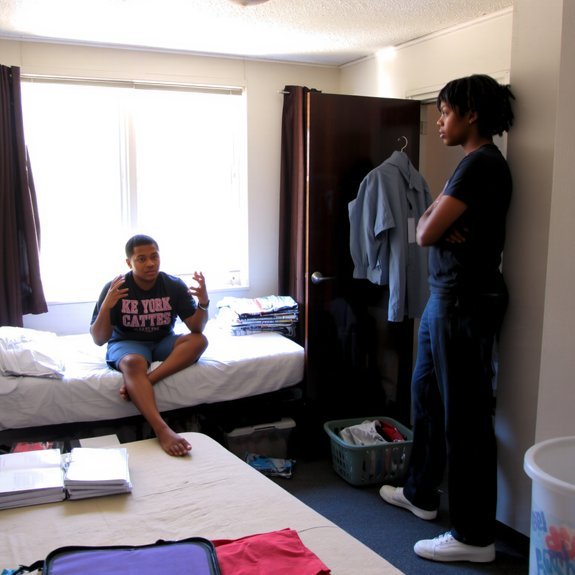
If you’re like me, you thought roommate drama was something only TV shows had—until you wake to someone blasting a playlist at seven a.m., and suddenly you’re wide-eyed, coffee half-spilled, and plotting polite revenge. You notice patterns fast: noise, dishes, and different sleep schedules collide. Smells hit you—curry at midnight, gym socks by the door—and you flare up, because small irritations pile into big grudges. Money talks get awkward, when rent or food splitting turns into texts you dodge. Privacy vanishes when guests arrive unannounced, or when your notes get read aloud like gossip. Cultural clashes and habits matter too; college life mixes backgrounds and expectations, and misread signals spark fights. You learn to spot roots before they bloom into drama.
Setting Clear Expectations Early On

Because nobody wants passive-aggressive Post-its stacked like tiny landmines on the fridge, I start roommate season like a slow-motion fire drill: we sit down, I brew coffee or grab a soda, and we lay out what actually matters. You’ll name the tiny stuff — overnight guests, noise after 11, who owns the Roomba — and the big stuff, like bills and cleaning. Say what you need, and listen when they answer; nod, sip, laugh at your own dramatic examples. Use concrete phrases: “I need quiet study time from 9–11pm” beats “be respectful.” Repeat agreements aloud, so they land. If someone hesitates, pause, ask why, and tweak till it feels fair. Early clarity saves late drama.
Creating a Shared Roommate Agreement

When things are calm, I make us do the roommate agreement like it’s a group project with snacks — you show up, I bring the pens and a playlist, and we actually write stuff down. You’ll list sleep hours, cleaning turns, guest rules, and who claims the prime shelf, with sticky notes and a laugh when someone writes “no judgment” as a rule. I’ll insist we sign and date it, then take a photo for backup — because phones never lie, right? Add a simple plan for chores, noise, shared groceries, and emergency contacts. Keep clauses short, concrete, and flexible. Revisit the paper each month, tweak what’s not working, and reward yourselves with pizza when you follow it for a week.
Communicating Effectively and Respectfully
You’ll want to set clear expectations from the jump—who cleans, who cooks, quiet hours—so nothing sneaks up on you at 2 a.m. Use “I” statements when something’s off, like “I feel overwhelmed when dishes pile up,” it keeps things honest without turning the room into a courtroom. Schedule quick weekly check-ins, five minutes with coffee or tea, and you’ll catch small stuff before it storms into a full-blown argument.
Set Clear Expectations
If we’re going to share a tiny kingdom of ramen bowls and late-night playlists, let’s cut the guessing game now — say what you expect, and mean it. I want you to walk into the room, point at the cluttered desk, and say, “This is my study zone,” not whisper hopefully. Name routine stuff: quiet hours, guest policies, who waters the plants, when dishes get done. Put it on paper, or a sticky note on the fridge, so you can both see it at 2 a.m. when tempers flare. Check in weekly, sip cold coffee, laugh at your past stubbornness, tweak the plan. Clear expectations aren’t romance, they’re a map — follow it, and you’ll avoid most detours.
Use “I” Statements
I’m not here to lecture — I’m here to hand you a phrase that actually works: start sentences with “I” instead of pointing fingers. Say, “I feel overwhelmed when the music’s loud at midnight,” not “You’re always too loud.” Your words land softer, like a knock instead of a shove. You lower defenses, you invite problem-solving. Look them in the eye, breathe, name the feeling, state the need: “I’m distracted, I need quiet.” Add a concrete action: “Can we agree on volume after 11?” Use calm tone, not guilt or sarcasm — sarcasm smells like passive-aggression, trust me. If you mess up, own it: “I said that poorly, I’m sorry.” That kind of honesty builds trust faster than ultimatums ever will.
Schedule Regular Check-ins
Try setting one regular check-in a week — five minutes over cereal, ten after dinner, whatever fits. I tell you, it’s like oil for the roommate engine. You sit, breathe the coffee, joke about the sock situation, then get real: what’s working, what’s loud, what’s smelling weird (yes, I mean that mystery Tupperware). Keep it short, specific, and kind. You ask, they answer. You set one or two small goals: quieter music after 11, dishes within a day, sharing the thermostat. Scribble decisions on a sticky note, hang it on the door like a tiny treaty. If things flare, you pause, take five, reschedule. These check-ins stop grudges, build trust, and make dorm life less dramatic, more doable.
Navigating Cultural and Identity Differences
When you walk into our dorm room and smell someone’s cinnamon candles clashing with my grandmother’s spicy stew memory, don’t look surprised — you’re in a cultural soup, and we’re both tasting it. You notice my photos, I notice your playlist, we both notice the different ways we say hello. Say what you need, without sounding like a textbook. Ask curious questions, not interrogation ones. Point out habits that bug you, I’ll try to explain where they come from. Trade recipes, swap songs, claim a shelf for incense and one for hot sauce, compromise like grown-ups who still giggle. Laugh when you mess up, apologize fast, mean it. Celebrate differences as tools, not threats. You’ll learn, I’ll learn, we’ll live better.
De-escalation Strategies for Heated Moments
When things heat up, you’ve got to slow your breathing, count to four, and feel the room settle—no heroic speeches, just oxygen. Use “I” statements to name what you feel, not what they did, and say, “I’m getting loud, can we pause?” If that’s still too tense, step out, grab air, and agree to revisit the conversation in thirty minutes, because calmer you is the smarter you.
Stay Calm, Breathe
Even if your palms are sweating and your voice wants to sprint, you can slow the room down—right now—by taking a breath that actually counts; I mean a solid, belly-filling inhale, hold for two seconds like you’re stalling for time, then let it out slow enough to hear the whoosh, and repeat. Do it again, and notice your shoulders drop, your jaw unclench, the fluorescent hum softens. Say to yourself, “One breath,” like a tiny command center. Anchor to the chair under you, the carpet fibers underfoot, the mug’s warm rim. Count quietly, tuck your elbows in, soften your eyes. You’ll sound calmer, even if you still want to win. It buys space, clarity, and a chance to pick your next words.
Use “I” Statements
You’ve slowed your breathing, felt your shoulders unclench, and now you need words that won’t light the room on fire—so try talking like you’re reporting a small truth about yourself, not indicting someone else. Say, “I feel frustrated when dishes pile up,” not, “You never wash anything.” Speak plainly, picture the clink of a mug, the stale popcorn smell, the small pile on the sink. Use short lines: “I need help keeping the kitchen tidy,” then pause, look away, soften your tone. That tiny tweak flips blame into problem-solving, invites cooperation, and saves dignity. Keep it honest, specific, nonjudgmental. You’ll sound grown-up, human, relatable—yes, even charming—while steering the convo toward solutions.
Pause and Revisit
If a conversation’s heating up and your chest feels like it’s staging a protest, call a time-out—literally. Step back, breathe through a paper cup if you must, and say, “I need five.” You’ll sound human, not volatile. Walk to the window, feel the cool sill under your palm, count to thirty, and let your voice settle. Text a roommate, “Pause? Coffee in ten?” or wash your face, splash cold water, anything tactile to break the loop. When you return, set a rule: no yelling, one person speaks at a time. If you botched the pause before, laugh about it, own it, and try again. You’ll preserve respect, reduce drama, and actually fix things.
When to Involve Resident Advisors or Housing Staff
When roommate drama starts smelling like burnt popcorn and passive-aggressive sticky notes, don’t stew in silence—call in the folks who can actually do something about it. If you’ve tried calm talks, timed chores, and polite texts, and tensions still sizzle, knock on your RA’s door. Say, “We need help,” describe specifics — late-night noise, broken lock, safety concerns — bring receipts: screenshots, photos, dates. Housing staff step in when rules get broken, when anyone feels unsafe, or when problems drag on past your patience. They mediate, enforce policies, arrange room changes, and sometimes just act like adults you desperately need. Be clear, stay factual, ask about next steps, and breathe — you don’t have to carry this alone.
Using Campus Support Services and Counseling
Even if you’re proud of your DIY conflict-resolution skills, don’t treat campus counseling like a last-resort, dusty file in the back of your brain — go see them. I say that because you’ll get neutral ears, not more drama. Walk into the counseling center, feel the cool air, sit on the soft chair, and say, “My roommate and I keep clashing.” They’ll help you map the problem, teach breathing tricks that actually work, and role-play tough talks so you don’t sound defensive. Use mediation services, drop-in hours, or group workshops. You’ll leave with a plan, a follow-up date, and maybe a worksheet that makes you roll your eyes — but it helps. Trust me, it beats passive-aggressive sticky notes.
Conclusion
You’ll handle this like you’d untangle a knotted charger—patient, a little annoyed, and oddly satisfied when it works. I want you to say what you need, listen like you mean it, and write a roommate pact you both can actually follow. Check in, use “I” lines, and laugh at the small stuff. If things boil, pull in an RA or counseling. You’re not fixing the world, just making your room livable.