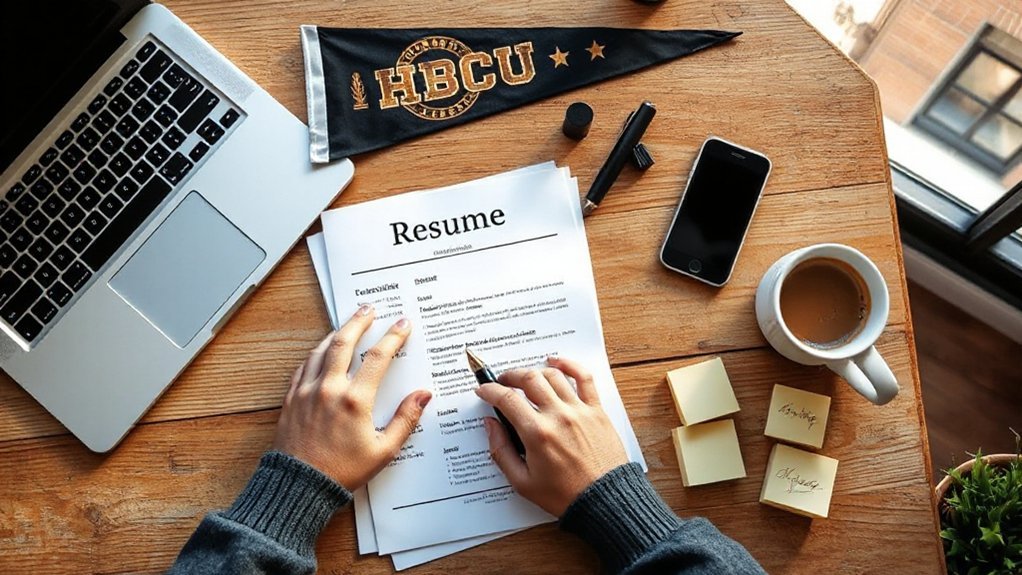
You’ve got stories—classroom wins, org nights, summer internships—and they should snap off the page, not snooze on it; I’ll help you turn service trips into leadership lines, tough courses into marketable skills, and alumni clout into real opportunities, all while keeping your resume clean, bold, and actually readable, so hiring managers don’t need caffeine to get through it. Stick with me and we’ll make your HBCU experience impossible to ignore—next up: what to cut and what to shout.
Key Takeaways
- Open with a concise summary that states your major, career goal, and one standout HBCU-driven skill or achievement.
- Convert class projects into results-focused bullets showing tools used, the problem solved, and measurable outcomes.
- Frame campus leadership and organizations as leadership experiences with specific actions, scope, and impact metrics.
- Describe internships and research as mini-stories: role, key contributions, and quantifiable results or improvements.
- Tailor keywords, reorder bullets for each job, and trim unrelated content to match the target role’s requirements.
Crafting a Strong Resume Summary That Reflects Your HBCU Experience

Okay, let’s get real: your resume summary shouldn’t read like a dusty textbook or a LinkedIn autopilot poem. You’ll want a sharp opening line that smells like confidence, not desperation. Say who you are, what you do, and the unique HBCU lens you bring — drop a tangible result, a number, a moment that glints. Picture walking into a room, shaking hands, handing over a one-sentence snapshot that makes them nod. Use vivid verbs, cut filler, and show culture-forward leadership without listing roles. You don’t need to name every club, just the impact: grew attendance 40%, launched mentorship nights, or led a fundraising sprint that bought new lab gear. Keep it tight, human, and impossible to ignore.
Translating Coursework and Campus Leadership Into Marketable Skills
You’ve got classroom wins and campus hustle that employers want, so let’s turn that lab report or student organization presidency into something they can actually picture. Translate a class project into a problem you solved, name the tools you used, and toss in a number—hours saved, people reached, or budget managed—to make it pop. I’ll show you how to highlight leadership roles, quantify those transferable skills, and even make your humble group chat planning look like strategic experience.
Translate Class Projects
Imagine this: you’re staring at a pile of graded projects, club minutes, and a half-finished event plan, wondering how any of that gets you hired. You can turn those pages into proof. Pick a project, name the goal, cite your role, show results — even small wins count. Say you led research, drafted a pitch, or debugged code, and include numbers or outcomes. Describe the room, the late-night coffee, the whiteboard full of arrows. Be specific, tactile, honest — employers like real work, not hype.
- Convert class deliverables into job-language, note tools and methods.
- Quantify impact: percent improved, hours saved, attendees reached.
- Link projects to skills asked in listings.
- Add brief, sharp context lines.
Highlight Leadership Roles
You already turned a messy stack of class projects into résumé gold — now let’s put campus leadership on the same shelf. You led student orgs, planned late-night fundraisers, and chaired tense meetings — you smelled coffee, felt adrenaline, fixed crises. Say that. Use titles, dates, one-line context, then a short punch: what you did, how you rallied folks, and the concrete outcome that followed. Don’t bury the action in fluff. Write, “President, Black Student Union — organized 12 events, recruited 40 members, partnered with local businesses,” not a paragraph of vague praise. Swap “helped” for verbs: launched, negotiated, coached. Quick scene: you convincing a skeptical sponsor over lunch — that snapshot sells. Own the messy moments; they prove you lead.
Quantify Transferable Skills
Three numbers tell a story faster than a paragraph: hours, people, dollars. You turn classes and club nights into proof. Say “led 12-week project, 40 hours, improved turnout 30%,” instead of vague praise. You frame lab reports as problem-solving sprints, group projects as team leadership, and fundraising as revenue skills. I tell you, hiring managers love specifics; they picture you in action.
- Converted class project into a prototype used by 25 peers.
- Organized weekly meetings for 60 students, cut no-shows by 45%.
- Managed $1,200 budget, negotiated vendor discounts, saved $300.
- Tutored 10 classmates, raised average grades by one letter.
Quantify it, own it, and watch your resume do the talking.
Highlighting Internships, Research, and Community Engagement
Because internships, research, and community work are the loudest proof of your hustle, I make them sing on my resume — and you should, too. I list roles like mini-stories: what I did, tools I used, results I moved. Say you revived a campus garden; note plants saved, volunteer hours logged, funding secured. In research, name your hypothesis, methods, and a clear outcome — poster, publication, or that aha moment at 3 a.m. For internships, swap vague duties for accomplishments: cut costs, boosted engagement, streamlined a process. Community work gets impact metrics: people served, events run, partnerships built. Use active verbs, keep lines tight, and let each bullet show sound, motion, and outcome — you did stuff, prove it.
Formatting and Design Tips for Clarity and Professionalism
If you want your resume to read like a clear, confident handshake, start by treating layout like choreography: give your eyes a place to land, a beat to follow, and no surprise trip hazards. I mean it — white space breathes, margins hug content, and fonts whisper professionalism. Use a readable sans-serif, bold only for headlines, keep bullets short, and scan for dead weight. Imagine a recruiter skimming at three seconds; make each line earn its keep, give visual cues, and steer them toward wins. Don’t cram, don’t glitter.
- Consistent spacing and margins for calm, neat flow.
- Clear section headings, same style, same size.
- Bullet points starting with strong verbs, short lines.
- One page if early career, two only if justified.
Tailoring Your Resume for Different Roles and Industries
When you’re aiming at different roles, think of your resume like a wardrobe change — same person, different occasion — and you’ve got to swap the sneakers for loafers without losing your stride. You’ll choose wording, reorder bullets, and highlight projects that smell like the job you want, not the one you had. For tech, lead with tools, code snippets, and measurable fixes; for communications, spotlight storytelling, campaigns, and engagement numbers. Trim unrelated fluff, keep verbs sharp, and match keywords from the posting, like a tailor fitting lapels. I’ll confess, it feels a bit like acting, but it’s honest acting — you’re showing the right scene. Save one crisp accomplishment per role, proofread aloud, then send it out like you mean it.
Leveraging HBCU Networks, Career Services, and Alumni Connections
Three people in a room can change your career faster than a hundred generic job posts, and your HBCU campus is full of those three-people moments—study-group confabs, late-night dining hall advice, alumni panels that smell like coffee and second chances. I want you leaning in, asking names, swapping emails, jotting down weird details that make follow-ups human. Use career services early, not as last-minute panic, get mocked-up resumes, practice interviews, record yourself flubbing answers and laugh. Tap alumni — you’ll be surprised how frank they are. Here’s where to start:
Three people in a room can change your career—lean in, swap names, use career services, and tap alumni.
- Schedule a resume review, bring drafts, expect tough love.
- Join student orgs, lead small projects, collect concrete bullets.
- Attend alumni mixers, ask “How’d you get here?” and listen.
- Get referrals, follow up with thank-you notes, stay visible.
Conclusion
You’ve got this — your HBCU story is a rocket strapped to a résumé, loud and proud. I want you to picture crisp bullet points punching like drumbeats, campus projects glowing like neon, and alumni calls landing like high-fives. Translate classes into skills, internships into wins, tweak one sentence per job, then send it. It’ll feel bold, maybe ridiculous, but it’ll work — because this resume? It’s yours, honest and unstoppable.